
How to Find Who Owns a Steuben County Property
Begin in the county assessment viewer and save the legal municipality and parcel identification number. Once the assessed owner appears, verify that name through the latest matching deed in SearchIQS. This address-to-parcel-to-deed path keeps false matches out of your answer.
- Search the address in the Steuben County Assessment Data and Parcel Viewer for the owner of record]
- Confirm the latest matching deed in SearchIQS]
- For an entity, preserve the grantee and use state business records only for context
- Use the public tax mailing address only for lawful property contact
Where Steuben County Owner Information Comes From
Three sources carry the evidence. The assessment roll gives a dated owner of record plus a mailing address. The deed names the recorded grantee and states the vesting. GIS ties both to a mapped parcel. Each layer adds proof; none stands in for the others.
| Source | Owner Info It Gives | Access |
|---|---|---|
| Assessor / tax roll | Dated assessment owner and tax-notice address | Official county portal |
| Recorder deed index | Recorded party receiving the described interest | Official County Clerk index |
| Secretary of State | Business context, not a replacement for the deed grantee | Official public record route |
| GIS parcel viewer | GIS owner field requiring roll and deed confirmation | Official parcel map service |
Titles and mailboxes do not always agree. An owner of record may live somewhere else entirely. An occupant may hold no title at all. The mailing address tells you where notices go, not who lives on the property.
What "Who Owns This Property" Cannot Tell You
Ownership records serve lawful property research. Do not publish needless personal details or use them to harass anyone. New York law still governs protected and confidential information.
Lawful use. [1-2 sentences - a Steuben County owner lookup is for property research and due diligence; using owner information to harass or intimidate anyone is a crime under New York law.]
Identify the Legal Steuben County Parcel First
The official Steuben assessment and parcel page anchors the lookup. It is where an address first pairs with a parcel and an assessed owner.
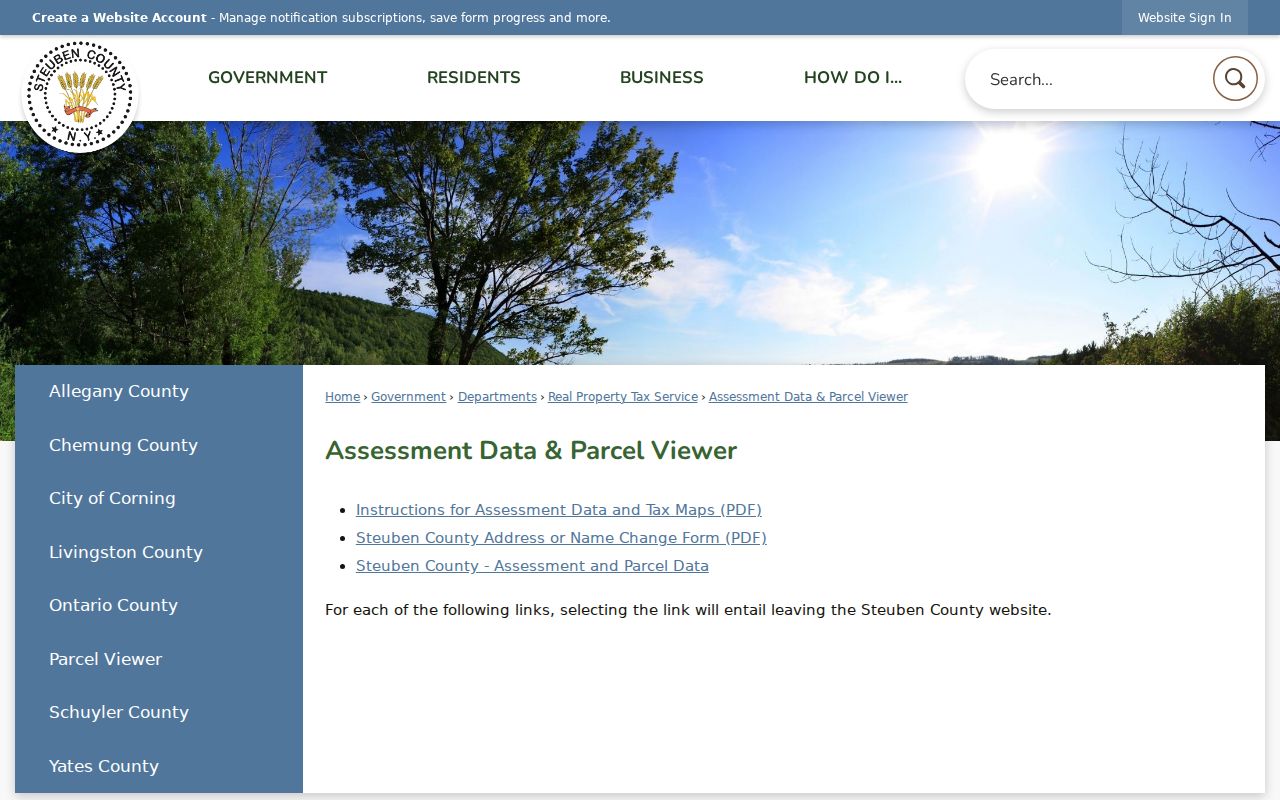
The page sets the search route. The dated parcel result plus the latest deed supply the proof behind any ownership conclusion.
To answer who owns a property in Steuben County, identify the parcel before anything else. Postal city names mislead. Search the county assessment viewer by street number and name. If that fails, shorten the street. Drop unit or directional text, try the prior owner, or switch to the county parcel layer. Keep the PIN or print key. Save the legal municipality, the SWIS-linked value, the property address, and the owner mailing address. Those fields separate a city parcel from land in a town or village. The village or town may share its mailing label.
Rural land complicates things further. A fire number, route designation, or renamed road may be the only address. One building can also sit on several tax parcels. Hold a separate row for each PIN. The deeds may still show a single ownership answer.
Read the Steuben Assessment Owner as a Dated Claim
The assessment roll names an owner of record for its own roll and update date. Treat it as the fastest official lead. It is not the final word, because it can lag behind a recent deed. Corning's municipal information warns plainly. Owner updates after a sale may take four to five weeks. Do not assume that timing applies to Hornell or any other assessing unit; ask the responsible assessor. Write the year and source beside every name you keep.
Read the mailing address for what it is. It is the destination for assessment and tax notices, not proof of residence. A tenant, manager, life tenant, beneficiary, LLC member, or trustee may never appear on that simple owner line. Use the field only for what it states.
Confirm Who Owns with the Latest Steuben County Deed
Take the assessed owner into SearchIQS and search that party as a grantee. Open the newest acquisition deed matching the municipality and legal description. Copy down the grantee and grantor. Note the recording date, book and page or instrument number, deed type, vesting language, and prior reference. A later transfer, correction, referee deed, executor deed, or tax conveyance changes the answer. Follow it before naming the current owner.
SearchIQS carries modern deed images from January 2, 1986 forward. Older index books and selected record-book images reach earlier periods. When a modern name search comes up empty, use the deed reference. You can also widen the dates, inspect the historical books, or contact the County Clerk. A current title conclusion may still require a professional search beyond the public index.
Understand Trust, Estate, and Entity Ownership
A deed can vest title in a trust. It can also name an estate representative, a corporation, or another entity. Report the grantee exactly as recorded. Never swap in a member, officer, beneficiary, agent, or mailing contact. New York business records can identify an entity and its service address. WebSurrogate can clarify an estate representative's authority. Neither changes the deed's grantee.
Joint ownership demands the same precision. Read the exact vesting language. Similar surnames prove nothing about family ties. A mailing address shared across parcels does not merge their ownership. Rely on the instrument and its legal description rather than private inferences.
Resolve Conflicts Between the Roll, GIS, and Deed
Source dates explain most mismatches. A deed may be recorded well before the assessor updates the owner field. A monthly county GIS edit can post after an annual state parcel publication. An older roll may deliberately preserve a former owner for a historical question. List each source with its date, municipality, parcel key, and name. Do not quietly pick one.
Differing identifiers or acreage point to a split, merger, correction, alias, or formatting change. Compare the deed's legal description and prior reference. Ask the assessor about the roll. Ask the Real Property Tax Service Agency about tax-map data. Ask the County Clerk about the recorded instrument. None of those offices issues legal title opinions.
Use Owner Information for Lawful Property Research
Ownership records earn their keep in lawful settings: purchase diligence, boundary and easement questions, tax disputes, estate work, deed-fraud review, and plain civic transparency. They were never meant to identify every occupant. New York law and custodian rules still protect confidential records, and no one should use these files to target, threaten, or harass a person.
Need to make contact? The tax mailing address is the one official public clue. Keep the message about the property itself. Skip publishing personal details that serve no purpose. For a legal notice, a transaction, or a disputed claim, rely on counsel or the procedure the law requires, since an informal note rarely carries legal weight.
Build an Auditable Steuben County Ownership Answer
A defensible ownership answer has a clear spine. Name the legal municipality and the exact parcel number. State the roll year and source date behind the assessed owner, cite the latest matching deed, and say whether the deed image itself was examined. Record the vesting language, flag any lag between the deed records and the tax roll, and note unresolved conflicts plainly. Keep the tax mailing address, the deed legal description, and any entity or estate context stated separately.
Label the limits too. GIS lines are not survey evidence. An assessment name is not guaranteed title. An index hit is not the full instrument, and an owner of record does not prove occupancy. That honest evidence trail lets another researcher reproduce the result and spot exactly where professional confirmation still belongs.